Sedo vs Bodis: Which Parking Service Pays More?
Ask where to park a domain and two names come back before you finish the question: Sedo and Bodis. The comparison deserves an honest frame before any feature list, because the biggest variable in parking revenue is not the platform logo, it is whether your domains have real traffic at all. With that said, the two services are genuinely different animals, and the differences start to matter the moment real visitors are in play.
Sedo vs Bodis at a glance
| Criterion | Sedo | Bodis |
|---|---|---|
| Core business | Marketplace and parking under one roof | Parking specialist |
| Parking revenue share | 80-90% of click revenue, per public reporting | No published headline figure; terms set per account |
| Sales integration | Built-in marketplace, auctions from $79 minimums, 10-20% sale commission | Parking-first; for-sale landers can point to a listing elsewhere |
| Geographic strength | Deep European and ccTLD buyer base | Broad international coverage |
| Best fit | Owners who want parking plus sales exposure in one place | Volume portfolios focused purely on parking yield |
Figures reflect publicly reported terms as of mid-2026. Both platforms adjust terms by account and traffic quality, so confirm current numbers before committing a large portfolio.
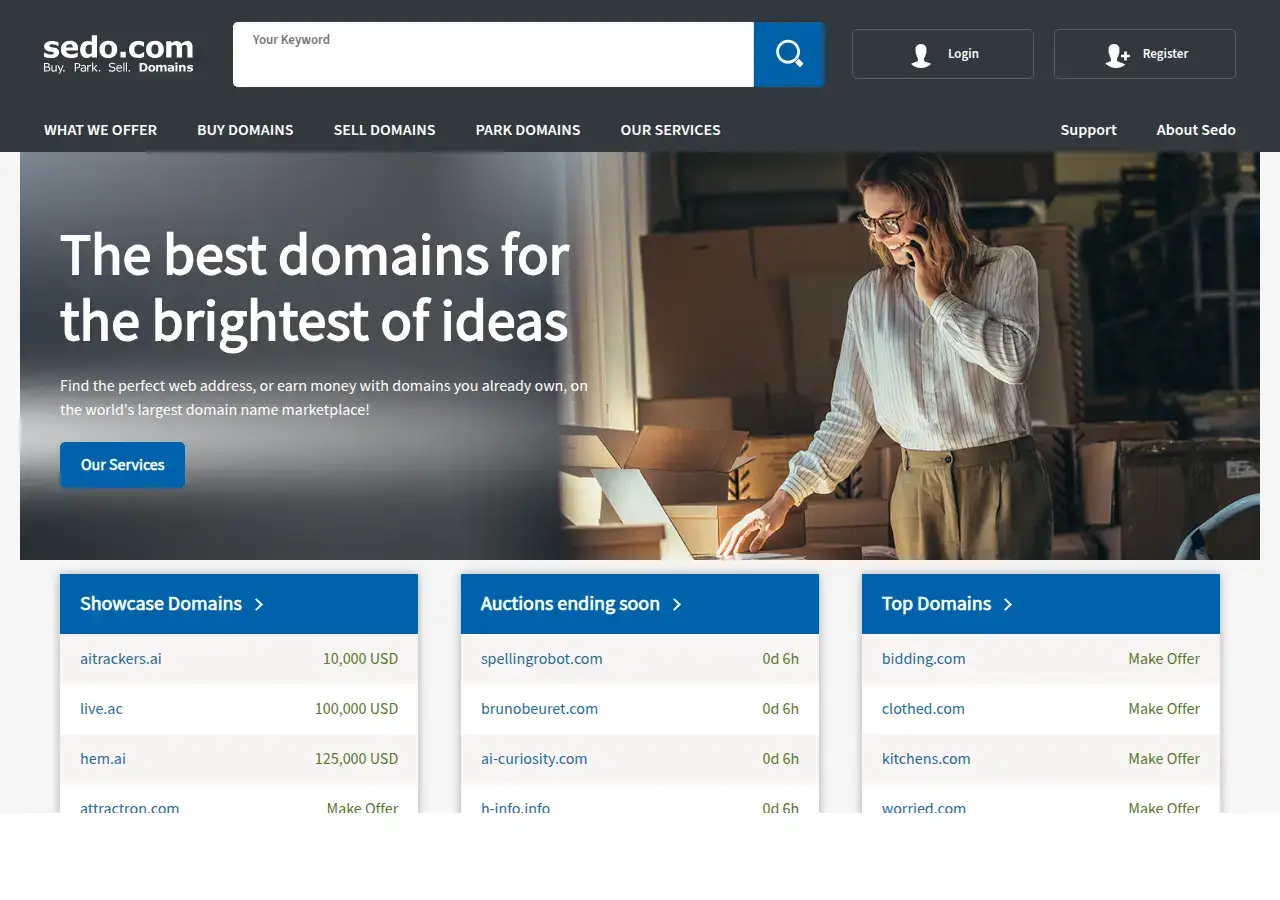
Sedo's homepage: marketplace and parking under one roof, captured August 2026
How do parking payouts actually work?
The mechanics are identical everywhere. A visitor resolves your domain, the platform serves a lander filled with ads from upstream feeds, and you receive a share of whatever the clicks earn. Because upstream demand comes from a small set of the same ad feeds, the raw price paid for a given click is similar across platforms far more often than marketing suggests. What platforms actually compete on is optimization, matching lander keywords and layouts to your traffic, and the share they pass through. Both levers together are worth less than the thing you control at purchase time: the quality, geography and intent of the traffic itself. The share ranges quoted in public reporting, like Sedo's 80-90%, apply to that final step, after the feed has already taken its own margin upstream.
Which numbers should you actually compare?
Three, in this order. Revenue per thousand visits (RPM) is the headline comparator, but only on filtered, human traffic; bot-heavy counts crush RPM and hide real differences. Click-through rate tells you whether the lander fits the traffic; a mismatch shows up as visits without clicks, and it is the number optimization actually moves. Payout share converts gross into net, which is where Sedo's reported 80-90% is a concrete advantage over unpublished terms, unless measured RPM says otherwise. Totals, the number dashboards showcase, are the least useful figure: they mix traffic volume you brought with performance the platform added.
So which one pays more?
There is no credible public head-to-head, and the community data cuts through the marketing: NamePros threads comparing the two are full of owners reporting near-zero revenue on both for portfolios without real type-in demand, which is exactly what the $3-5 monthly consensus for ordinary names predicts. Where owners do report differences, they are portfolio-specific: one service wins on a particular geographic mix or topic cluster and loses on another. Anyone quoting a universal RPM winner is generalizing from their own portfolio, or selling something. The only answer that holds is the one you measure on your own names.
The split-test protocol
Testing is cheap, so run the comparison properly. Split comparable domains into two groups and point each group at one platform for 30-60 days. Compare revenue per parked visit rather than totals, since one lucky click distorts small samples. Swap the groups for a second period to control for seasonality, watch the bot share in each dashboard, and then commit the portfolio to whichever service won on your traffic. Re-test yearly: feeds and optimization change, and last year's answer quietly expires.
Which mistakes ruin parking comparisons?
- Comparing totals across different months. Seasonality and advertiser budget cycles move parking revenue; only same-period comparisons mean anything.
- Judging on a handful of domains. A single lucky click on a small sample crowns the wrong winner; spread the test across enough names to drown the noise.
- Ignoring bot share. The platform reporting more raw visits is not paying more; RPM on filtered, human traffic is the honest metric.
- Testing traffic-less names. Both services pay near zero on domains without type-in demand, so such a test measures nothing; run it on your proven earners.
- Set-and-forget after one test. Feeds, shares and optimization all change; the winner of last year is not automatically the winner of this one.
Do Sedo and Bodis have the field to themselves?
No. ParkingCrew and a cluster of smaller networks compete on the same upstream feeds, and registrar-default landers quietly monetize plenty of names at unclear shares. Sedo and Bodis dominate the conversation because they combine scale with self-serve access for individual owners. The comparison logic in this piece applies unchanged to any pair: identical feeds upstream, optimization and share downstream, and your traffic quality deciding almost everything.
Verdict: choose by portfolio type
Choose Sedo when the marketplace matters: European or ccTLD-heavy portfolios benefit from its buyer base, the $79 auction minimums give liquidity a floor, and parking-while-listed suits sellers who expect exits, the pattern covered in our monetization framework. Choose Bodis when parking yield is the entire job and you want a specialist optimizing a larger volume. Hold both to realistic standards: as our parking revenue analysis shows, neither platform rescues names without real visitors. The bigger lever sits at acquisition, buying domains that arrive with genuine type-in demand, which is why traffic-filtered hunting in a tool like DomCop moves earnings more than any platform switch.
Frequently asked questions
What revenue share does Sedo pay for parking?
Public reporting puts Sedo's parking payout at 80-90% of click revenue as of mid-2026. Individual account terms vary with traffic quality and volume, so treat the range as a baseline to confirm, not a contract.
Does Bodis publish its revenue share?
No headline figure, terms are set per account. That is not automatically worse: an unpublished share with better optimization can out-earn a published one. It simply means you must measure your own RPM instead of comparing brochure numbers.
Can I use Sedo and Bodis at the same time?
A domain points at one parking service at a time via its nameservers, but nothing stops you splitting a portfolio between the two, which is exactly how you should test them before committing everything to either.
Do I need traffic history before a parking service accepts my domains?
Both services onboard ordinary portfolios; what varies with traffic quality is the terms and attention you receive. Cleaner, higher volumes generally earn better shares and support, one more reason to measure your traffic before negotiating anything.
Do parked domains sell better on Sedo?
Parked Sedo domains get marketplace exposure to its buyer base, with auctions from $79 minimums and commissions typically in the 10-20% range on sales. If exits are part of your plan, that integration is Sedo's strongest argument.